
ARIMA
Category: Rollforward & time series
Overview
Description | Forecasting function based on the autoregressive integrated moving average (ARIMA) model. Use when you want to forecast a time series from historical patterns without defining explicit driver nodes. |
|---|---|
Syntax |
|
Parameters |
|
Examples
Monthly forecast from historical data
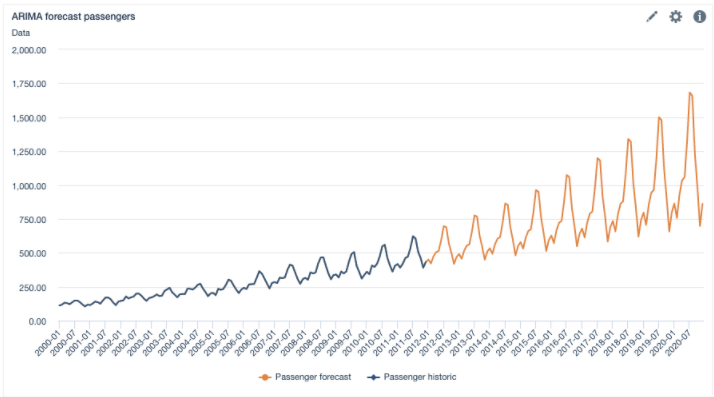
This example shows monthly historical passenger data used as the basis for an ARIMA forecast. The result keeps the historical observations and extends the series with forecasted periods to the end of the horizon.
Input node: Passenger historic
Data set: Passenger historic.xlsx )
Data horizon: 2000 - 2011
| Year | Month | Value |
|---|---|---|
| 2000 | 2000-01 | 112 |
| … | … | … |
| 2011 | 2011-12 | 432 |
Formula: ARIMA('Passenger historic', 1, 1, 1, 1, 0, 1, 12)
ARIMA horizon: 2000 - 2020
| Year | Month | → ARIMA Result |
|---|---|---|
| 2000 | 2000-01 | 112 |
| … | … | … |
| 2011 | 2011-12 | 432 |
| 2012 | 2012-01 | 450 |
| … | … | … |
| 2020 | 2020-12 | 861 |
Chart:
Related Functions
| Function | When to use instead |
|---|---|
| ROLLFORWARD_ADVANCED | When you want to project values with explicit driver nodes instead of forecasting from historical patterns alone. |
| MOVINGAVG | When you want to smooth historical values over a rolling window instead of creating a forecast. |